The Blog
Before the Snow Flies: A Fall Dog-Waste Cleanup Guide for Fairfield County & Westchester Yards
Why dog waste left on the lawn this fall matters for your kids, your grass and Long Island Sound, plus a 5-step pre-snow cleanup checklist. Every fact sourced.
It's time to talk sh*t. Seasonally.
Every fall the leaves come down, the yard gets raked (or doesn't), and then the first snow covers everything. Whatever your dog left on the lawn in November is still there in March, just harder to see. Here's why that matters and what to do about it in the few weeks before winter sets in.
1. Snow hides it. Melt moves it.
Stormwater isn't only rain. Westchester County's planning department defines runoff as rain or melted snow that flows over the ground instead of soaking in, and warns that pet waste left on the ground gets washed toward storm drains (Westchester County Dept. of Planning, "Stormwater"). Those drains aren't connected to a treatment plant: the county's stormwater guide notes that runoff is carried untreated to local streams, ponds, reservoirs, Long Island Sound and the Hudson River (Westchester County Dept. of Planning, "Step by Step").
Long Island Sound is the shared backyard for everyone in lower Fairfield County and southern Westchester. The Long Island Sound Partnership calls pet waste a major contributor to degraded water quality: its nitrogen and phosphorus feed algae growth and low oxygen (Long Island Sound Partnership). The U.S. EPA goes further, calling pet waste "a leading source of nutrient and bacteria pollution in urban streams and waterways" (U.S. EPA, "Stormwater Best Management Practice").
2. It adds up faster than you'd think
Connecticut's statewide bacteria plan estimates that each dog produces about 200 grams of feces a day, with fecal coliform counts as high as 23 million per gram (CT DEEP, Statewide Total Maximum Daily Load). The EPA's outreach fact sheet puts it in household terms: a single gram of pet waste, about the weight of a business card, carries an average of 23 million fecal coliform bacteria (U.S. EPA, "If You Think"; Long Island Sound Partnership).
There are a lot of dogs doing this. About 45.5% of U.S. households own a dog, or 59.8 million homes and 89.7 million dogs (Larkin).
3. The 2-to-4-week window (and why "it'll break down" doesn't work)
The health concern people tend to miss is roundworm. According to the CDC, Toxocara eggs shed in dog feces need 2 to 4 weeks in the environment to become infective, and once they are, they can survive in soil for months or even years (CDC, "How Toxocariasis Spreads"). The CDC's parasitology lab describes the eggs as extremely hardy (CDC, "DPDx"). Severe infections are more likely in young children, who play in dirt and put their hands in their mouths (CDC, "About Toxocariasis").
Washington State University Extension adds that hookworm larvae can become infective in 6 to 12 days, and that fresh droppings can carry Salmonella, Campylobacter and Giardia (WSU Extension). So the pile disappearing isn't the same as the problem disappearing.
The CDC's advice is simple: pick up pet waste daily, bag it and put it in the trash (CDC, "How Toxocariasis Spreads").
4. It isn't fertilizer, and it shouldn't go in the compost
Westchester County puts this one in capital letters: "Pet waste is NOT fertilizer!" (Westchester County Dept. of Planning, "Stormwater"). Connecticut's environmental agency agrees on disposal: always pick it up and put it in the trash, and don't compost it, even in a biodegradable bag (CT DEEP, "It's Greening Cats and Dogs").
What about those brown spots? Mississippi State University Extension notes that dog urine is the bigger lawn burner, since feces release their nitrogen slowly. Removing droppings before turf damage starts is still the recommendation (Mississippi State Univ. Extension).
5. The pre-snow checklist: 5 orders before the first flake
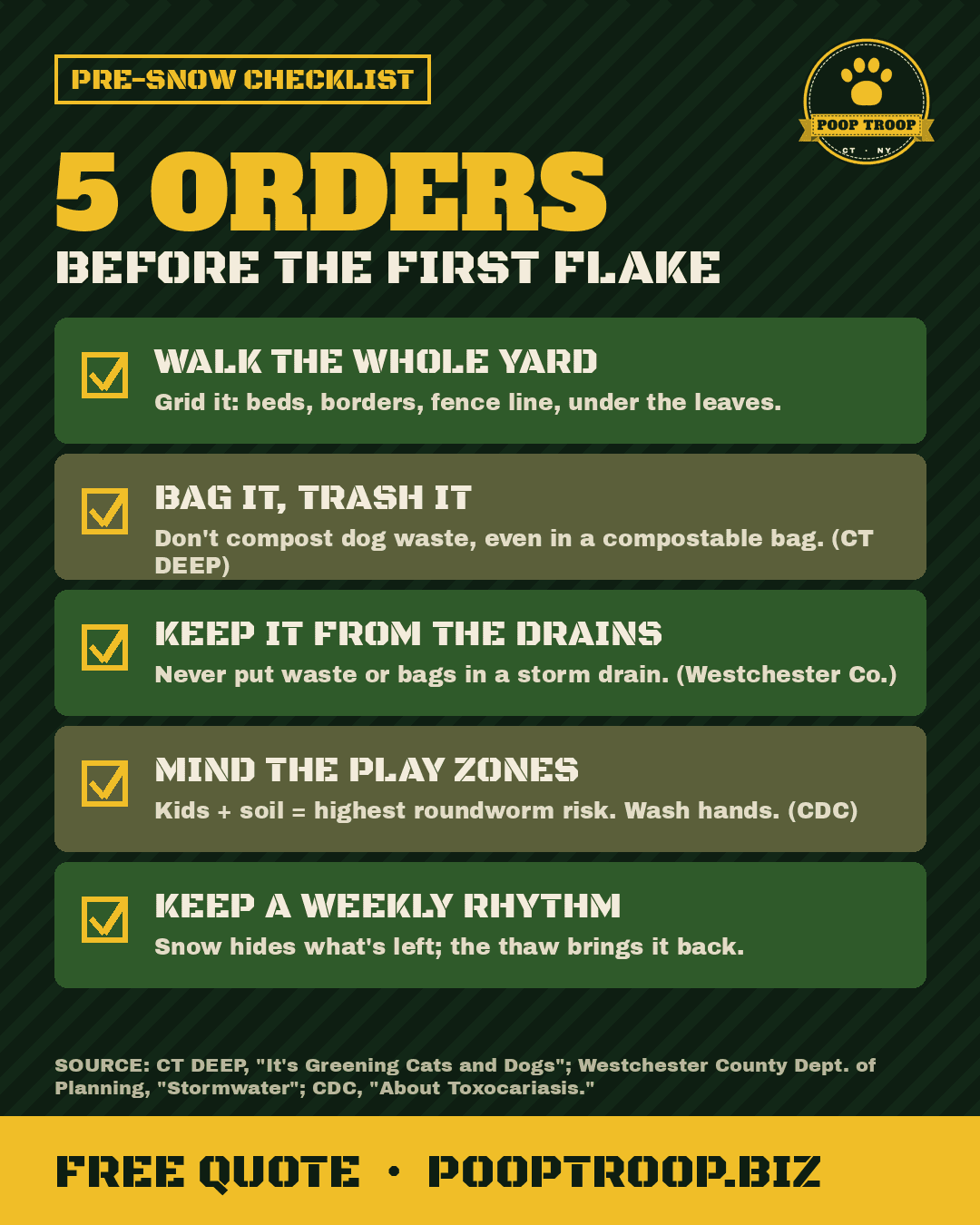
- Walk the whole yard. Grid it: beds, borders, the fence line and under the leaves. Fallen leaves are excellent camouflage.
- Bag it, trash it. Not the compost pile, even in a compostable bag (CT DEEP).
- Keep it away from the drains. Never put pet waste or bags in a storm drain (Westchester County Dept. of Planning).
- Mind the play zones. Where kids play and dig, pickup matters most. Wash hands after yard time (CDC).
- Keep a rhythm through winter. Snow hides what's left; the thaw brings it back. Keep up your own pickups, and if you want a backstop, set a standing weekly visit.
Where Poop Troop fits
We're building standing weekly routes across lower Fairfield County and Westchester. Here's how a visit works, straight from our service pages:
- Same day each week, and you don't need to be home.
- A grid walk of the whole yard, with complete removal and haul-away.
- The gate photographed and secured, plus a short note after every visit.
- Weather: we keep the appointment when it's safe and make up any miss.
- Deodorize or sanitize on request. One-time cleanups and HOA waste stations, too.
- No contracts. Pause anytime.
Get a free quote at pooptroop.biz. We reply within one business day. Want yard tips and route news? Join the list.
MISSION: ACCOMPLISHED.
— The Poop Troop team
Works Cited
- Centers for Disease Control and Prevention. "About Toxocariasis." CDC, www.cdc.gov/toxocariasis/about/. Accessed 2 Nov. 2026.
- Centers for Disease Control and Prevention. "DPDx: Toxocariasis." CDC, www.cdc.gov/dpdx/toxocariasis/index.html. Accessed 2 Nov. 2026.
- Centers for Disease Control and Prevention. "How Toxocariasis Spreads." CDC, www.cdc.gov/toxocariasis/spreads/. Accessed 2 Nov. 2026.
- Connecticut Department of Energy and Environmental Protection. "It's Greening Cats and Dogs." CT.gov, portal.ct.gov/deep/p2/individual/its-greening-cats-and-dogs. Accessed 2 Nov. 2026.
- Connecticut Department of Energy and Environmental Protection. A Statewide Total Maximum Daily Load Analysis for Bacteria Impaired Waters. Dec. 2025, portal.ct.gov/-/media/DEEP/water/water-quality-action-plans/tmdl/ctfinaltmdl/stwdbact_tmdl_corefinal.pdf.
- Larkin, Malinda. "Pet Population Continues to Increase While Pet Spending Declines." AVMA News, American Veterinary Medical Association, 10 Oct. 2024, updated 6 Nov. 2024.
- Long Island Sound Partnership. "Canines for Clean Water." Long Island Sound Partnership, lispartnership.org/canines-for-clean-water/. Accessed 2 Nov. 2026.
- Mississippi State University Extension. "'Dog-On-It' Lawn Problems." Turf Tips, 10 Sept. 2007, extension.msstate.edu/newsletters/turf-tips-newsletter/2007/dog-it-lawn-problems-09-10-07.
- United States, Environmental Protection Agency. "If You Think Picking Up Dog Poop Is Unpleasant, Try Swimming in It." Nonpoint Source Outreach Toolbox, cfpub.epa.gov/npstbx/files/cwc_petwastefactsheet.pdf. Accessed 2 Nov. 2026.
- United States, Environmental Protection Agency. Stormwater Best Management Practice: Pet Waste Management. EPA-832-F-21-032E, Feb. 2023, www.epa.gov/system/files/documents/2023-01/bmp-pet-waste-management.pdf.
- Washington State University Extension, Clallam County. "Managing Pet Waste." WSU Extension, extension.wsu.edu/clallam/watershed-stewardship/managing-pet-waste/. Accessed 2 Nov. 2026.
- Westchester County Department of Planning. "Stormwater." Westchester County Planning, planning.westchestergov.com/?id=142&start=10&view=category. Accessed 2 Nov. 2026.
- Westchester County Department of Planning. Step by Step: A Guide to Stormwater (archived). planning.westchestercountyny.gov/images/archive/stories/pdfs/stepbystep.pdf. Accessed 2 Nov. 2026.
Begin
Begin a standing appointment.
Tell us about the property. We'll reply with a free quote within one business day.