
The Blog
Dog Poop Is Not Fertilizer: 6 Myths About Dog Waste, Your Lawn and Your Health
Six myths about dog waste, your lawn, and your health, checked against the EPA, CDC, Connecticut DEEP, and Westchester County. Every fact sourced.
It's time to talk sh*t. Here are the six things we hear most about dog waste, and what the people who study it actually say.
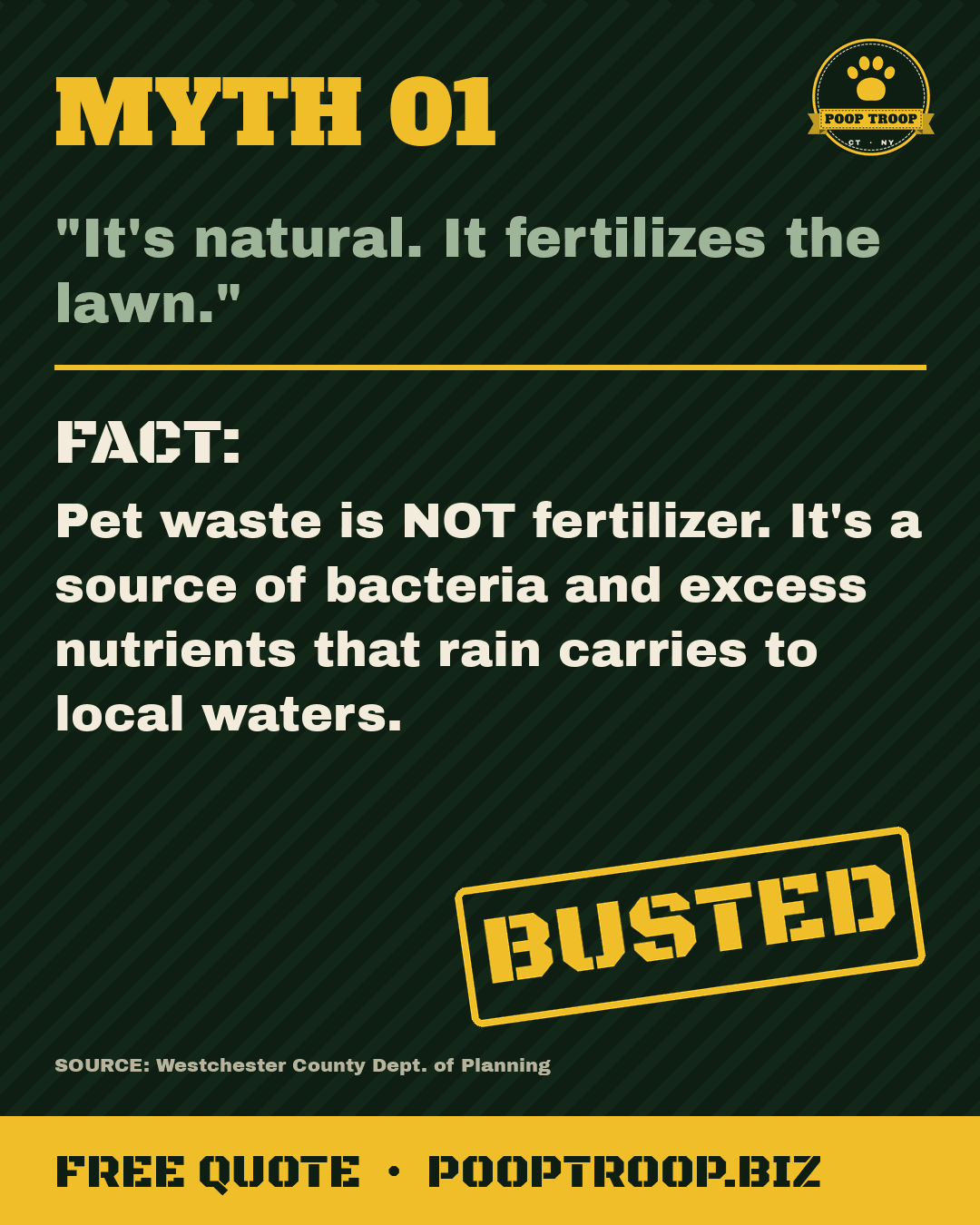
Myth 1: "It's natural. It fertilizes the lawn."
Fact: Westchester County's stormwater office says it plainly: "Pet waste is NOT fertilizer!" It's a source of bacteria and excess nutrients that runoff carries to local waters (Westchester County Dept. of Planning, "Stormwater"). The U.S. EPA calls pet waste "a leading source of nutrient and bacteria pollution in urban streams and waterways" (U.S. EPA, "Stormwater Best Management Practice").
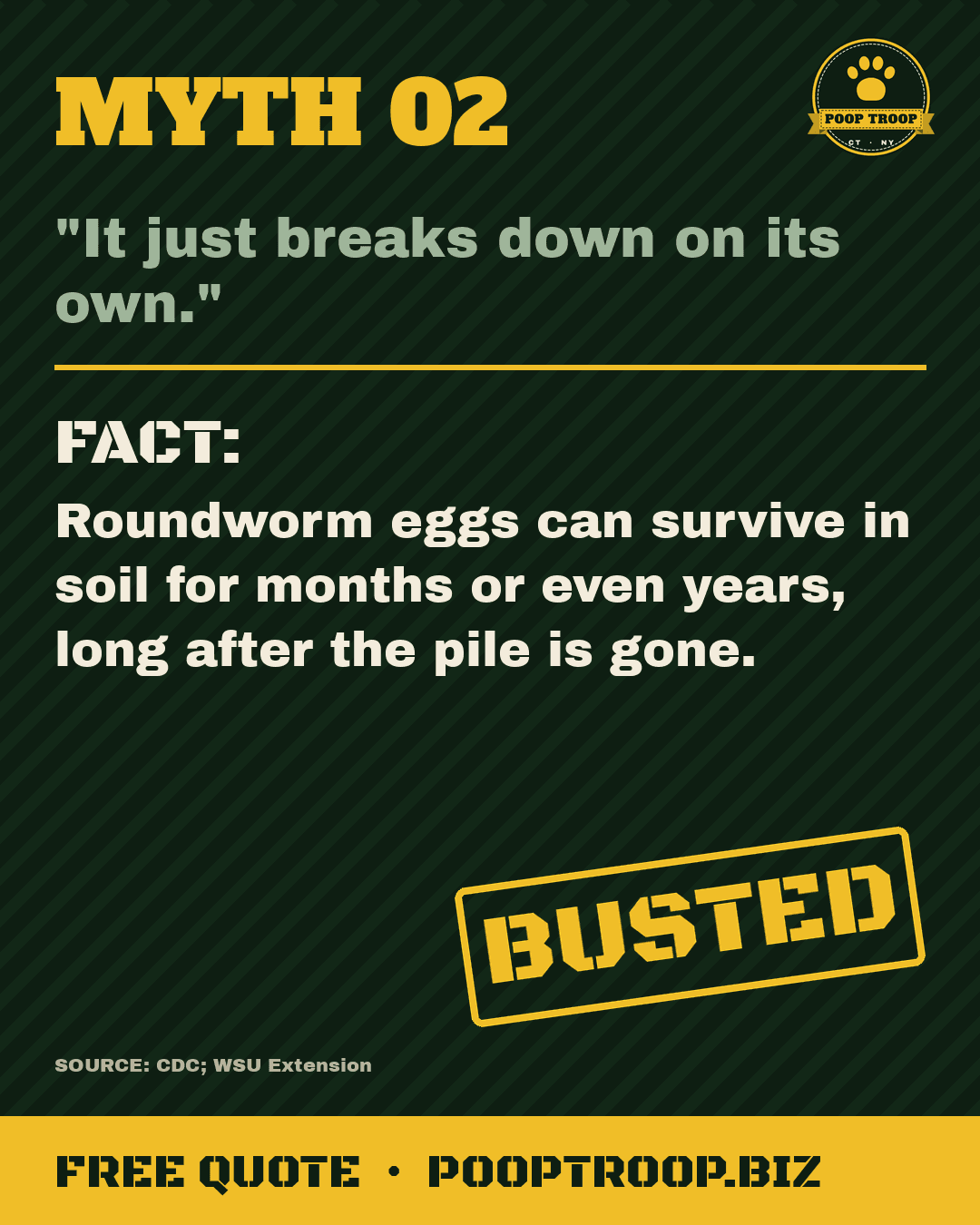
Myth 2: "It just breaks down on its own."
Fact: The pile can disappear while the problem stays. The CDC says roundworm (Toxocara) eggs from dog feces become infective after 2 to 4 weeks and can survive in soil for months or years (CDC, "How Toxocariasis Spreads"). WSU Extension notes roundworm eggs can stay viable in soil for years (WSU Extension).
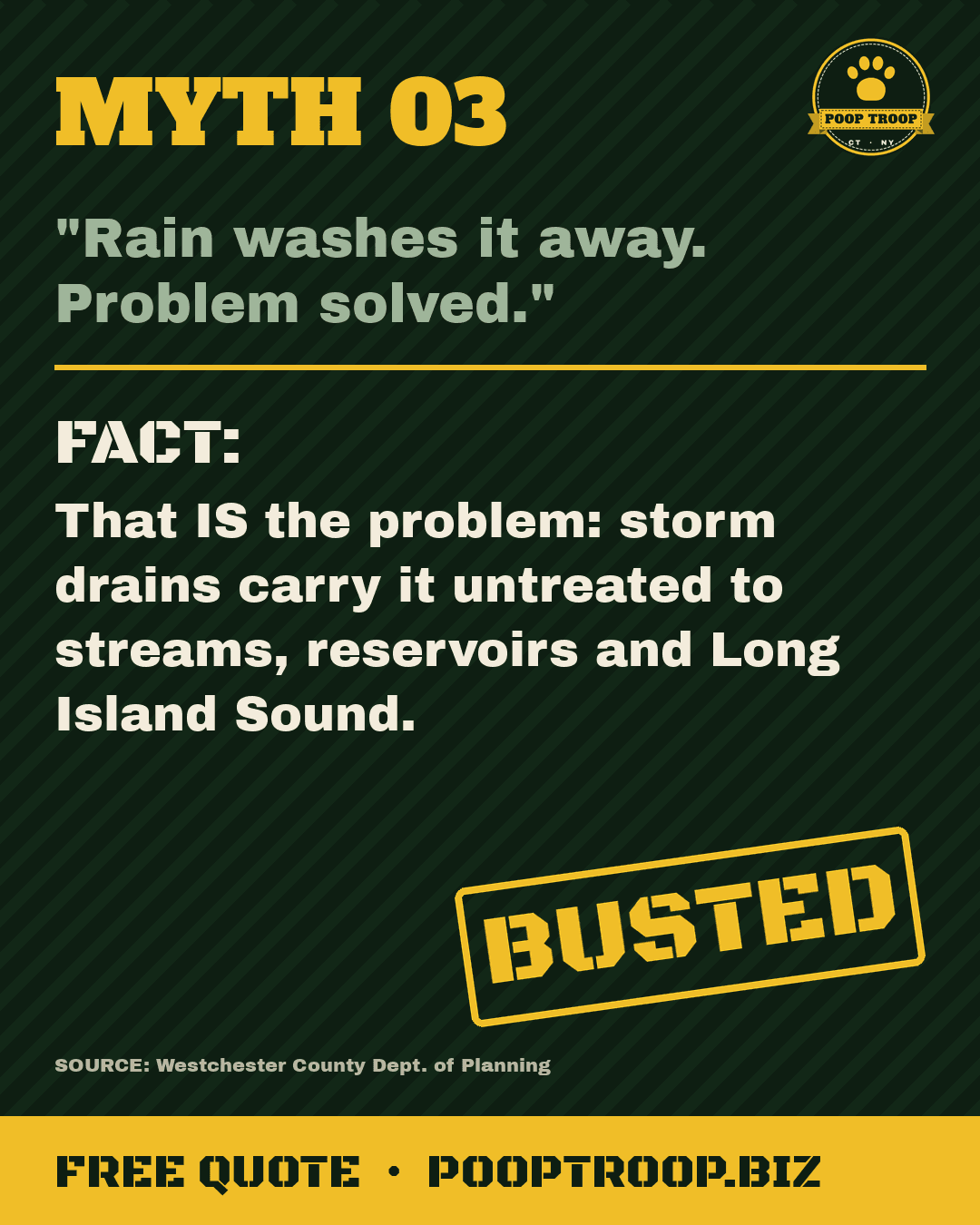
Myth 3: "Rain washes it away. Problem solved."
Fact: That is the problem. Runoff from rain and melted snow goes to storm drains and is carried untreated to streams, ponds, reservoirs, Long Island Sound and the Hudson (Westchester County Dept. of Planning, "Step by Step"). In the Sound, pet waste's nitrogen and phosphorus feed algae and low oxygen (Long Island Sound Partnership).
Myth 4: "Composting it is the eco move."
Fact: Connecticut's environmental agency says to always pick it up and put it in the trash, and not to compost it, even in a biodegradable bag (CT DEEP, "It's Greening Cats and Dogs").
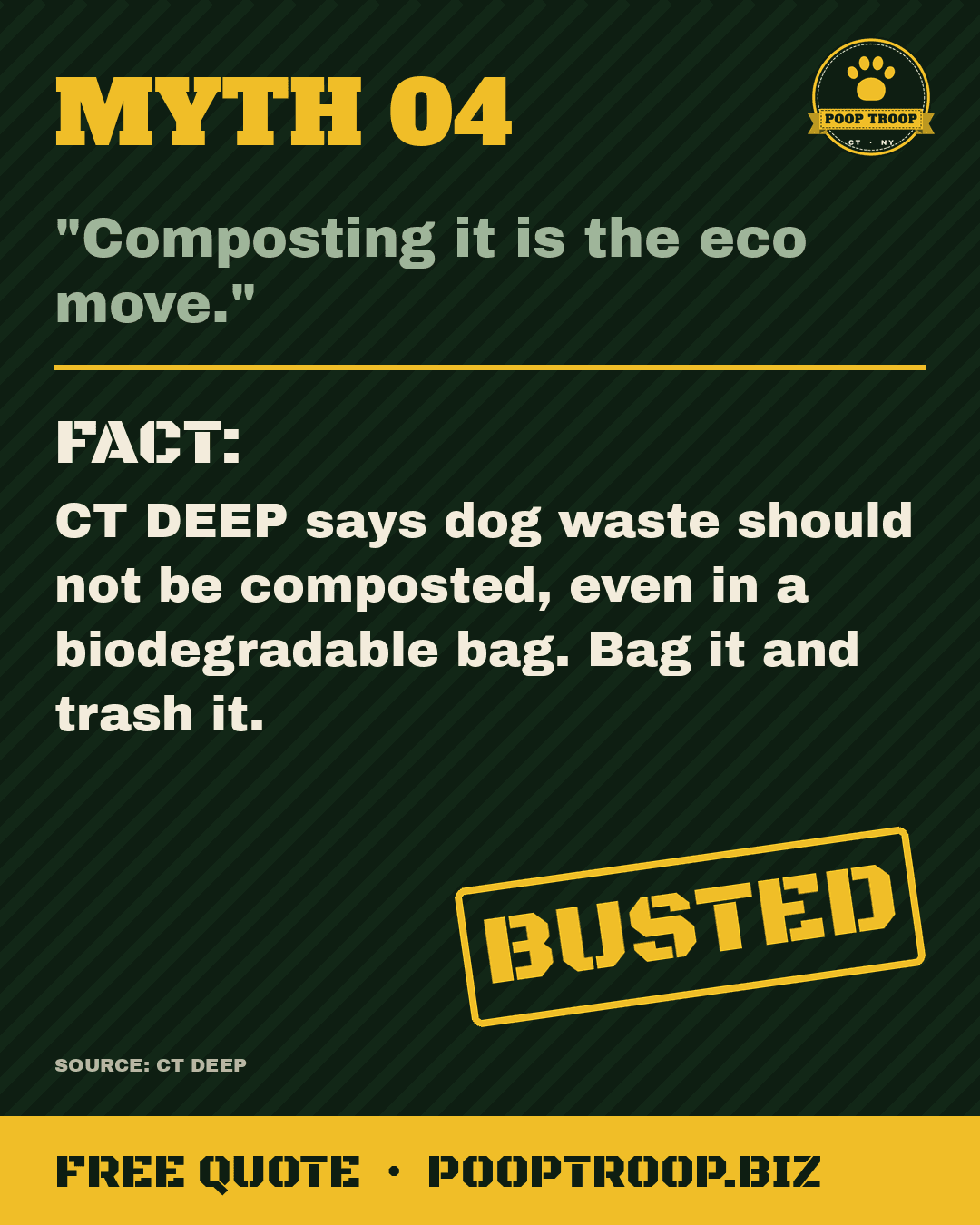
Myth 5: "Brown spots? Must be the poop."
Fact: Urine is the bigger lawn burner. Feces release nitrogen slowly, and the recommendation is to remove them before turf damage starts (Mississippi State Univ. Extension).
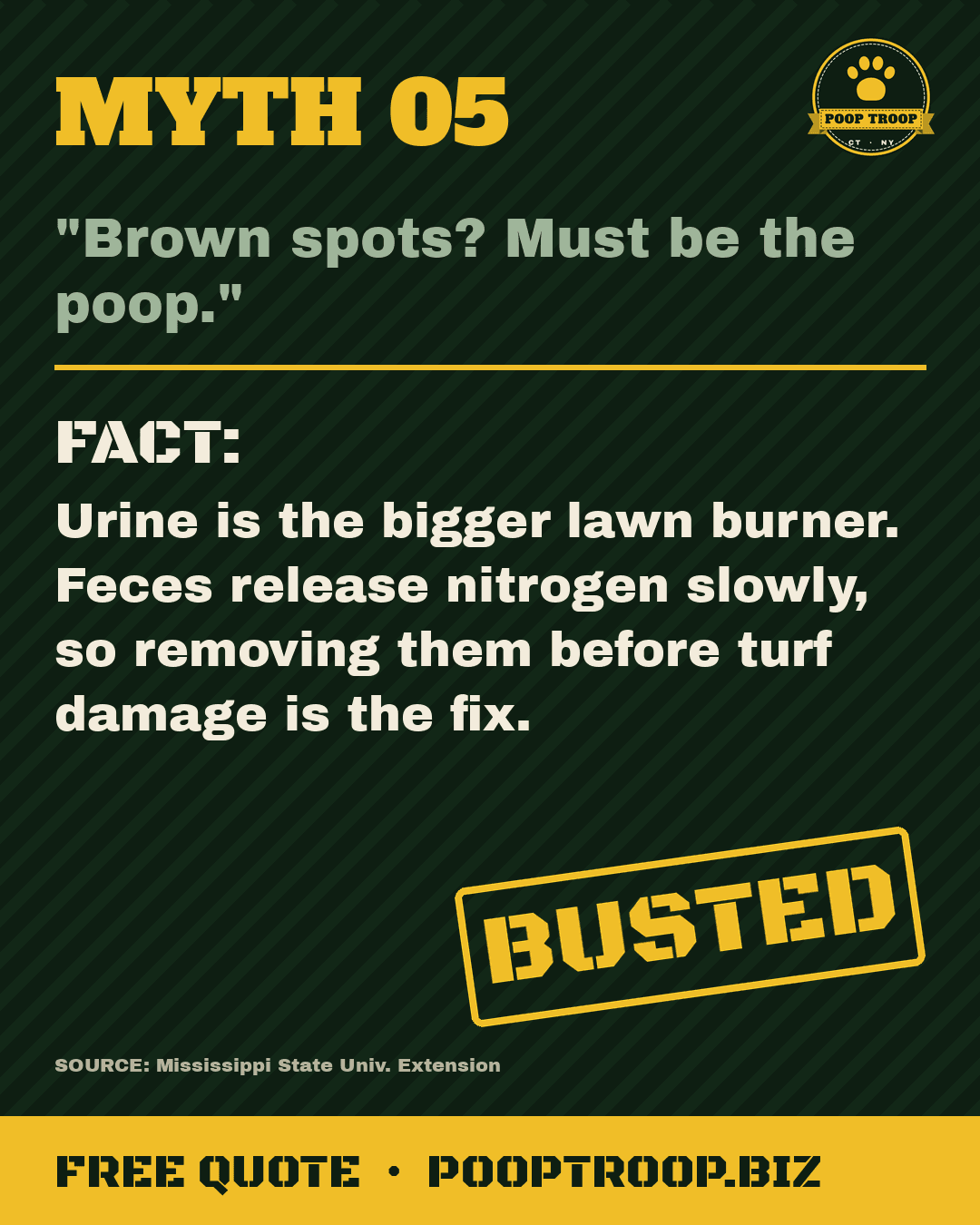
Myth 6: "One dog can't make much difference."
Fact: Connecticut's statewide bacteria plan estimates about 200 grams of feces per dog per day, with fecal coliform as high as 23 million per gram (CT DEEP, Statewide Total Maximum Daily Load). With about 89.7 million dogs in U.S. homes (Larkin), it adds up.
The bottom line
Pick it up, bag it and trash it. The CDC recommends picking up pet waste daily (CDC, "How Toxocariasis Spreads"). If you want a backstop, Poop Troop runs standing weekly visits across lower Fairfield County and Westchester: a grid walk of the whole yard, complete haul-away, gate photographed and secured, no contracts.
— The Poop Troop team
Works Cited
- Centers for Disease Control and Prevention. "How Toxocariasis Spreads." CDC, www.cdc.gov/toxocariasis/spreads/. Accessed 2 Nov. 2026.
- Connecticut Department of Energy and Environmental Protection. "It's Greening Cats and Dogs." CT.gov, portal.ct.gov/deep/p2/individual/its-greening-cats-and-dogs. Accessed 2 Nov. 2026.
- Connecticut Department of Energy and Environmental Protection. A Statewide Total Maximum Daily Load Analysis for Bacteria Impaired Waters. Dec. 2025, portal.ct.gov/-/media/DEEP/water/water-quality-action-plans/tmdl/ctfinaltmdl/stwdbact_tmdl_corefinal.pdf.
- Larkin, Malinda. "Pet Population Continues to Increase While Pet Spending Declines." AVMA News, American Veterinary Medical Association, 10 Oct. 2024, updated 6 Nov. 2024.
- Long Island Sound Partnership. "Canines for Clean Water." Long Island Sound Partnership, lispartnership.org/canines-for-clean-water/. Accessed 2 Nov. 2026.
- Mississippi State University Extension. "'Dog-On-It' Lawn Problems." Turf Tips, 10 Sept. 2007, extension.msstate.edu/newsletters/turf-tips-newsletter/2007/dog-it-lawn-problems-09-10-07.
- United States, Environmental Protection Agency. Stormwater Best Management Practice: Pet Waste Management. EPA-832-F-21-032E, Feb. 2023, www.epa.gov/system/files/documents/2023-01/bmp-pet-waste-management.pdf.
- Washington State University Extension, Clallam County. "Managing Pet Waste." WSU Extension, extension.wsu.edu/clallam/watershed-stewardship/managing-pet-waste/. Accessed 2 Nov. 2026.
- Westchester County Department of Planning. "Stormwater." Westchester County Planning, planning.westchestergov.com/?id=142&start=10&view=category. Accessed 2 Nov. 2026.
- Westchester County Department of Planning. Step by Step: A Guide to Stormwater (archived). planning.westchestercountyny.gov/images/archive/stories/pdfs/stepbystep.pdf. Accessed 2 Nov. 2026.
Begin
Begin a standing appointment.
Tell us about the property. We'll reply with a free quote within one business day.